

The curtains have closed on another CITES Conference of the Parties — and what a remarkable CoP it was. As a team, we continue to marvel at this extraordinary, complex, sometimes bewildering process. Imagine trying to guide 185 nations — each with its own languages, priorities, histories, and economic realities — toward shared decisions on conservation and international trade. Even defining a single term can take days. Yet that is the heart of CITES: painstaking negotiation to protect the world’s most vulnerable wildlife.
Frankly, it still feels deeply counterintuitive — even troubling — to debate any form of trade in threatened or endangered species. But this is the arena we are in, and if we want to influence outcomes, we must speak the language of those casting the votes: economics, sustainability, and long-term viability. That is how conservation wins here. And this year, countries sought us out. Delegates took our meetings, asked us to explain our positions, and engaged with our arguments. That level of access and respect is no small achievement — it reflects years of credibility, persistence, and relationship-building by the Sea Save team.
Because the truth is simple: without international agreements, greed wins. With them, wildlife still has a chance.
The world is finally recognizing the value of biodiversity in place.
Science, economics, and lived experience are converging. Healthy ecosystems are worth far more alive than depleted. Intact habitats stabilize climate, safeguard freshwater systems, nurture pollinators, protect coastlines, enrich soils, store carbon, and keep natural food systems functioning.
And then there is ecotourism: long-term, sustainable revenue that far exceeds the short-term payout of killing a species for sale. The world is beginning to understand what science has told us for decades: thriving biodiversity is not a luxury. It is planetary life-support.
The foundations are now laid for a new era of conversations — ones that place ecological function and long-term prosperity at the center.
And now, the victories: decades of Sea Save advocacy rewarded.
This CoP brought historic wins — many for species Sea Save has championed for decades. In a stunning show of unity, nearly all species proposals were adopted by consensus. That means every single Party supported them.
In the final 24 hours — often the most nerve-wracking stretch, when every decision must be recited aloud and can still be reopened — 99% of the earlier agreements held. And with that, the following species achieved the highest or strengthened protections under international law:
Now on Appendix I (no international commercial trade):
• Whale sharks
• Oceanic whitetip sharks
• All manta and devil rays (Mobulidae)
• Marine iguanas (Galápagos)
New or strengthened Appendix II protections (regulated international trade):
• Entire families of smoothhound and gulper sharks
• Golden sandfish
Retained on Appendix II with a zero-quota (no commercial trade allowed):
• Giant guitarfish
• Wedgefish
These decisions will save animals measured not just in numbers, but in futures.
Two losses — and one nearly-redeemed victory.
Only two proposals ultimately failed to gain enough votes:
• Eels, due to enormous commercial demand — especially for glass eels
• Actinopyga sea cucumbers, blocked by similar market pressure
But there was a moment of genuine hope. The sea cucumber proposal was reopened during plenary — very rare — and received strong support in a second vote. It came heartbreakingly close. Not enough to pass, but close enough to signal: next time, the world may be ready.
And we will be ready, too.
To our Virtual Delegates — those who signed up for daily emails: you were with us every step.
Sharing this experience with you — our Virtual Delegate community — has kept us motivated and energized across long days, late nights, and endless negotiations. Knowing you were watching, cheering, asking questions, and pushing us onward meant the world.
For everyone else, thank you for following our journey — and look for the Ocean Week in Review to return this week.
And we want to say something clearly:
You made this possible.
Your support is why we are here. These historic protections exist today because of years of advocacy, education, persistence, and the belief that together we can change outcomes for species that would otherwise disappear.
From our entire team, thank you. These victories belong to all of us.
Signing off from Uzbekistan — proud, deeply grateful, and already preparing for the battles ahead.
With appreciation,
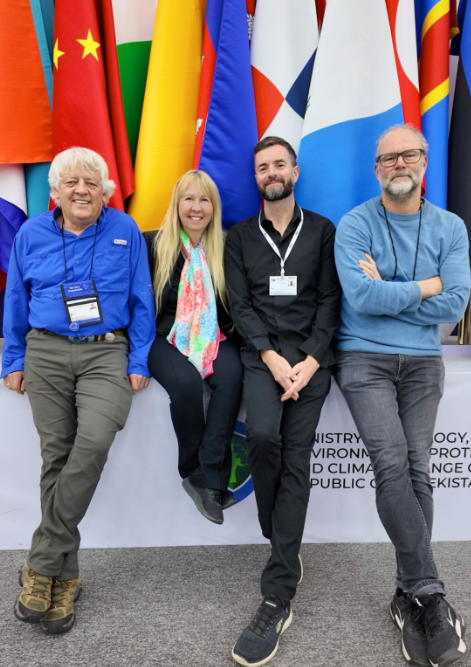
Georgienne, Phil, Toby and Jay
Sea Save Foundation Delegation
CITES CoP20 – Uzbekistan