

Let’s talk about marine iguanas. You might ask why Sea Save is following this reptilian proposal. You probably wouldn’t question it if we were talking about seals and sea lions, that would an seem obvious match.
Seals and sea lions come ashore to bask in the sun and to breed, but all of their food lives in the sea. Marine iguanas are exactly the same, they are the only lizards to live entirely on seaweed, making their health uniquely tied to the fate of the oceans.
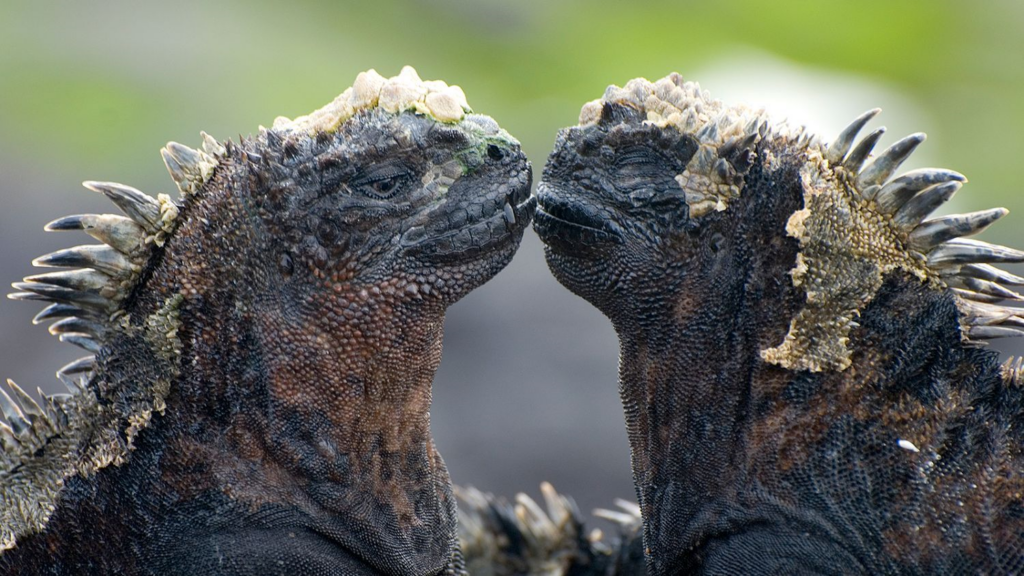
Galapagos is the most famous island archipelago, because as species from the mainland arrived they found a land of opportunities, and quickly evolved into new species. Often not only one new species, but many, as creatures moved from island to island in the chain, and evolved into different forms to exploit resources unique to each island. It was here that Darwin solidified his ‘Origin of Species’ theory, because he saw how a mainland finch had diversified into many forms throughout the Galapagos. Iguanas did the same. A couple of intrepid iguanas washed up on the beaches of Galapagos, castaways from the mainland, carried on flotsam, until the currents washed them ashore. Some became land iguanas, but others arrived on islands with very little vegetation; they needed to carve out a new niche. And so, they became the only lizards in the world to live on seaweed.
Like all reptiles, even marine turtles, they must lay their eggs on shore – so they haven’t completely abandoned the land. And because they are cold bloodied, they must bask in the equatorial sun to charge-up their bodies before they confront the cold water. But once warmed, they take to the sea.
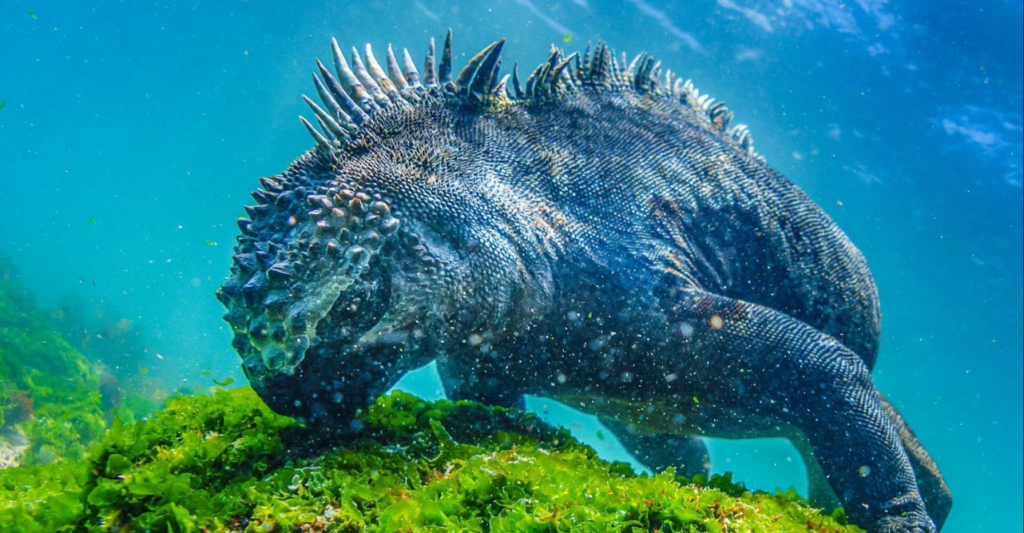
Galapagos has fierce currents, but with powerful swipes of their tails the iguanas descend, sometimes as deep as 30 metres. Using sharp claws to anchor themselves to rocks, they graze algae for as long as they can hold their breaths (for about 30 minutes). They keep feeding until they are getting too cold to swim. Then they must return and recharge in the sun. It’s a gruelling lifestyle. It’s made even more complicated by the unique relationship these islands have to ocean currents. For most of the year the Galapagos is bathed in cold water currents. The Humbolt and Cromwell currents bring cold water from the frigid depths of the ocean. As they sweep up the steep shores of the archipelago they push nutrients from the seabed to the surface, and mixed with equatorial sun, life proliferates. The seas team with fish. It’s these riches that feed the islands penguins, seals and other unique species, and there is algae in abundance for the iguanas. Ironically, this rich season in the water, is a time of hardship on land, the dry season, when land iguanas struggle to find food. But for them, better times are coming. The rainy season is caused by a switch in currents. Now the islands are bathed by the Panama current; warm water from central America. This stops the underwater nutrient pump. Fish leave the shallows. Penguins and seals must go further offshore to hunt. And the marine iguanas face months of hardship, as algae is in short-supply.
This hot water season is much more extreme during El Nino years, and can result in huge mortality among marine iguanas. They simply can’t find enough food. El Nino events are intensifying because of climate change, so this unique species faces an uncertain future.
However, this is not of concern to CITES. Remember CITES exists to regulate international trade. Because the species of Galapagos are unique and live on a much-celebrated world heritage site, they have never been available for international trade, they are completely protected.
But in recent years marine iguanas have appeared in the pet trade. Clearly, as there has never been trade, these first animals were taken from the wild illegally. Now young lizards are being offered as captive bred. They command high prices, selling for $25,000 per specimen!
It’s possible they have been bred in captivity, but also possible it’s providing convenient labels to hide more young iguanas that have been stolen from the wild.
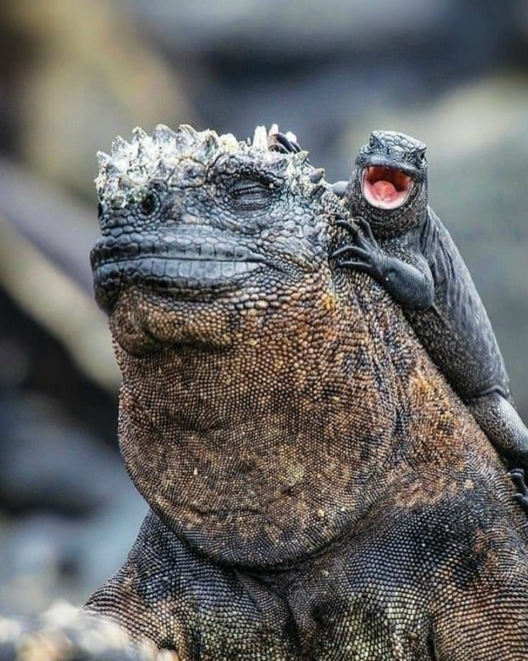
Today a proposal was adopted by consensus, meaning all of the world’s nations supported the notion, to put marine iguanas on Appendix I – that means no trade of any sort is allowed, so this loophole can be shutdown. It’s a good day for marine iguanas!
I’d just like to make one more observation. Over this CoP I’ve heard Australia’s delegation speaking out in support of proposals, and have voted to end trade in threatened sharks and rays. But in this same week I have seen heart-breaking video of sharks and manta rays trapped in the shark-nets that surround some of Australia’s beaches this week. I’m not pointing a finger at Australia, all nations play their part in threatening wildlife (although they do need to sort out this awful net issue that kills so many animals, including non-aggressive sharks, rays, turtles, dolphins and whales unnecessarily), but it’s a reminder that trade is only part of the equation. Wildlife faces many threats, so our work is far from done.
Now this morning we head into the last two days of CITES. During this time we hope to see all of the proposals ratified, adopted by committee so that they can quickly be transferred into law. So stand by for the final reports!
Thank you for helping us be a part of this historic conference.
Best wishes,
Phil, Georgienne, Jay, and Tobias
CITES CoP20, Uzbekistan